Sepehr Mahmoudian
I build domain-specific AI agents and custom harnesses for auditable workflows, alongside AI software for LLM/VLM evaluation and traceability, knowledge graphs and Graph RAG. My research spans Partial Information Decomposition (PID), information-theoretic representation analysis, computational neuroscience, robotics and multimodal 3D perception. Mostly Rust and Python.
Focus
Selected work
How the work relates
The map shows protocol interfaces, libraries, tools, and assets. Applications select the components they need.
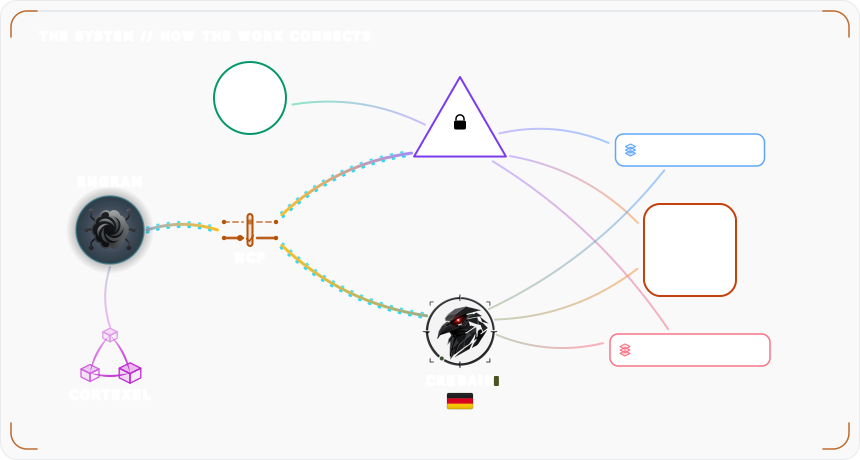
Open diagram · zoom and explore · Original SVG: light · dark

Read the connections: Filled arrowheads show where data, assets or messages go. Open arrowheads point to a library that a project uses.
- Local NCP 1.0 interface: solid paired arrows for requests and results on each owner's own process channel, with the released local SDK 1.0.0.
- Uses a library: dashed line with an open arrowhead at the library.
- Sensor data path: long dashed line with a filled arrowhead toward the recorder.
- Haldir: authorized commands, NCP wire 1.0: single solid arrow into NCP: Haldir checks each signed controller intent and publishes only the command it authorizes, with its own authority lease, on the wire 1.0 release candidate and outside the local profile. Nothing returns to Haldir over NCP: the candidate wire has no authority feedback, and intents arrive through Haldir's own admission interface.
- Mesh dataset: dotted line with a filled arrowhead toward the simulator.
- Asset or model tool: dashed line with a filled arrowhead toward the simulator.
CREBAIN has no pid-rs dependency. Its recordings reach pid-rs through Prisoma's optional information analysis. Engram renders its figures through Cortexel's figure contracts.
Different jobs: Engram runs neural models. CREBAIN runs a standalone 3D environment and sensor fusion. Galadriel optionally checks sensors for possible tampering. Prisoma organizes experiments and evidence for embodied agents. NCP defines their shared messages.
Neural loop: Engram runs NEST networks. It sends action proposals to the CREBAIN body simulation and receives sensor data through NCP.
CREBAIN and Prisoma: Prisoma records each command before CREBAIN executes it. It joins the related sensor and neural steps into one experiment record.
Local four-program composition. Engram, CREBAIN, Prisoma, and Galadriel can run together as one local experiment. Each program owns its state.
The Engram source is in the private Paper2Brain repository. The public Engram repository is a placeholder. Read about NCP.
Components and sensors
CREBAIN runs standalone. Applications can add Engram neural models, Prisoma recording, or Galadriel monitoring. One endpoint can expose several identified sensors.
Each camera and microphone keeps its identity and timing. Prisoma defines features, source groups, targets, and statistical assumptions. pid-rs estimates the declared quantities for two to four source variables. NCP does not limit the number of sensors.
cobot-atlas supplies robotics meshes, and relief-atlas supplies disaster-relief and defense meshes for CREBAIN scenes. Melkor converts Gaussian-splat scenes for CREBAIN and wraps external reconstruction programs. Manwe makes perception models for CREBAIN sensors.
The four-owner reference routes CREBAIN observations to Engram and returns its action proposals. Galadriel records diagnostics, and Prisoma captures complete exchanges. Applications can select smaller compositions through the modular interface.
Engram coordinates one local experiment and owns the neural state. CREBAIN owns the body and fusion state. Prisoma records the step pairs. Galadriel records the detector output.
Each owner exchanges bounded requests and results through its own private process channel. NCP defines the shared contract.
Galadriel compares at least two sensor modalities. It reports when the evidence is not sufficient.
Scope: The composition runs in local simulation. Haldir publishes the commands it authorizes through its own NCP wire 1.0 interface, outside this composition. Capture and monitor results never send commands.
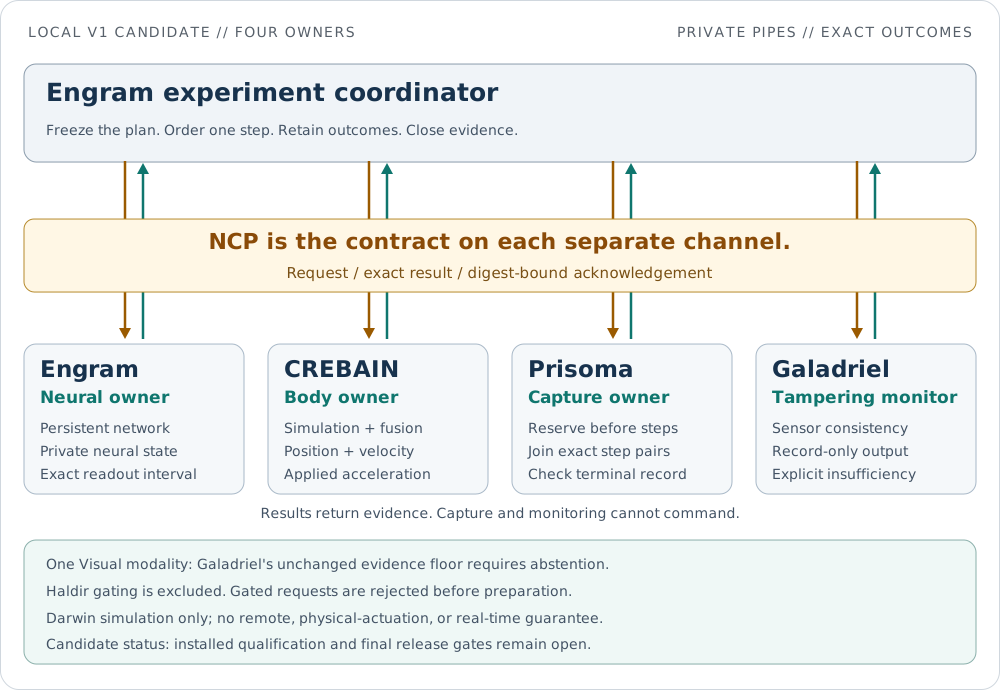
Open diagram · zoom and explore · Original SVG: light · dark

- engram : Engram runs experiments with biophysical and functional neural models. An AI agent and custom harness record model sources, simulation inputs, and results. Its optional NCP controller connects NEST networks to the CREBAIN body simulation. The public repository remains a placeholder pending source publication. The source is in the private Paper2Brain repository.
- NCP : NCP defines typed messages for neural controllers, simulations, sensor monitors, and experiment capture. Each program keeps its own process and state. An application selects the programs that it needs. Engram, CREBAIN, Prisoma, and Galadriel exchange requests and results through the released local SDK 1.0.0. Haldir publishes the commands it authorizes through its own NCP wire 1.0 interface.
- prisoma : Prisoma develops experiments for action-conditioned world models. Its Agent Bridge records each command and the original NCP exchanges. You can replay and analyze each experiment from these records. Prisoma uses pid-rs for optional information analysis of CREBAIN sensor recordings.
- crebain : CREBAIN is a standalone drone simulation with RGB images, microphone pressure, and thermal radiance. It is also a platform for sensor-fusion research. Optional NCP interfaces connect it to Engram neural controllers, the Prisoma recorder, and the Galadriel sensor monitor. Its scenes can use meshes from cobot-atlas and relief-atlas and Gaussian splats that Melkor converts.
- melkor : Melkor provides deterministic 3D Gaussian Splatting (3DGS) conversion across PLY, SPZ and glTF. Its inspection reports surface field provenance, bounds and numeric hazards without modifying source assets. The current release candidate is source-only; no production binary is currently supported.
- galadriel : Galadriel is an optional Rust monitor for possible sensor tampering and persistent measurement anomalies. It compares predictions with measurements, examines changes over time, and checks agreement between sensor modalities. When the evidence is not sufficient, it reports this. An alert does not identify its cause. Its NCP adapter records assessments and has no command authority. Galadriel uses pid-rs for information diagnostics.
- pid-rs : pid-rs is a safe-Rust library for shared-exclusions Partial Information Decomposition and mutual-information estimation: categorical SxPID, KSG MI and default-off experimental continuous shared-exclusions/PID surfaces. v0.9.0 is a GitHub-only source-review prerelease.
- haldir : Haldir Gate authorizes mission commands one at a time. It checks each signed controller intent against held authority, trusted state, replay history, and a deterministic policy. It publishes only its own command frames and records a receipt for each decision. It publishes each command over NCP wire 1.0, the release candidate, with an authority lease that it issues. It operates outside the local four-program composition.
- manwe : Manwe is an airspace-perception research workbench for vision, audio, multi-camera geometry, and multi-target tracking. It has a Python numerical and training package and Rust/Candle inference benchmarks. It makes candidate perception outputs for systems such as CREBAIN.
- cortexel : Cortexel is an unreleased TypeScript library and CLI for neural-simulation figures: it validates and canonicalizes strict declarative JSON requests with fail-closed provenance, then returns deterministic SVG plus a complete exact-value table. main is 0.10.0-dev.0; v0.9.0 is the last tagged preview.
- relief-atlas : relief-atlas is a Python generation pipeline and 10,079-item manifest and prompt catalog for disaster-relief, humanitarian-aid and civil-protection meshes. The repository currently contains 125 GLBs, not a complete 10,079-mesh corpus.
- cobot-atlas : cobot-atlas is a Python generation pipeline for a public MIT dataset of 2,023 unique glTF 2.0 Binary meshes (2,024 GLB files, 33.5 GB) for robot/cobot simulation, manipulation research, VLA training and benchmarking. Hugging Face dataset · Dataset DOI · Pipeline DOI
Writing & research
- [Re] Measures for investigating the contextual modulation of information transmission : ReScience C 6(3), 2020 · reproducibility repository.
- Google Scholar : publications.
- Substack : notes & essays.
FAQ
Who is Sepehr Mahmoudian?
A Senior AI Engineer based in Berlin, Germany, with more than a decade of experience across applied AI, research software and computational neuroscience. He builds domain-specific AI agents and custom harnesses, and works across LLM/VLM evaluation and traceability, knowledge graphs, Graph RAG, robotics and multimodal 3D perception. GitHub member since 2014.
What does he work on?
Domain-specific AI agents and custom harnesses; LLM/VLM evaluation, traceability and observability; knowledge graphs and Graph RAG; information-theoretic representation analysis and Partial Information Decomposition; robotics and multimodal 3D perception, primarily in Rust and Python.
What is his current research?
His PhD dissertation is in final preparation. Its core develops new mathematical PID analyses and information-theoretic methods for studying neural representations. A supporting research-software ecosystem includes Engram, a research-stage, domain-specific AI agent and custom harness for provenance-aware, closed-loop simulations of biophysical and functional neural models, alongside validation, perception and control tools for reproducible, auditable computational-neuroscience R&D.
What are his main projects?
His selected work spans computational neuroscience, neural-control protocols, intervention-grounded VLA-policy diagnosis, spatial awareness and airspace perception, statistical consistency and authorization monitors, 3D Gaussian-splat tooling, deterministic scientific visualization and synthetic 3D datasets. Each project above links to its public repository and evidence.
Has he published research?
Yes, including the ReScience C replication [Re] Measures for investigating the contextual modulation of information transmission. Publications are listed on Google Scholar.
Where is he based and how can he be reached?
Berlin, Germany. By email at sepmhn@gmail.com, or via the links below.
Curriculum vitae
Public three-page editions in English and German.